Sebastian live from the Arctic!
April 17, 2009 4:12 am


Visit The Last Great March - Fire + Ice Site
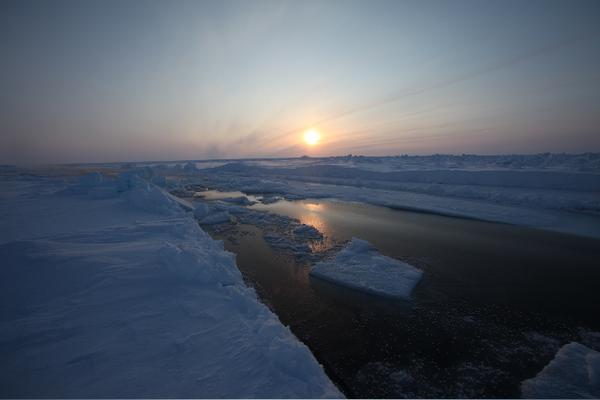
You can tell a “wet” or open lead from a frozen one for the discoloration on the ice at the water’s edge. A wet lead has a brownish hue which noticeably breaks from the duotone spectrum of white and blue of the Arctic ice. From an ice mound even just a couple of feet high, you can spot a large open lead from a distance; and invariably, tension sets into the pit of your stomach. An open leads means business: it will generally cut your route (for obvious reasons you are more likely to run into an east/west lead when traveling north), and challenge you for a strategy to bypass it. Often, this will involve a calculated risk. At best, a wet lead will cost you time; at worst it will kill you. We crossed so many open leads today (the strong winds of the last few days have surely helped put more cracks in the ice) that I lost count. Sivce the sea ice feels and looks like a desert, it’s a always a mind twisterr to acknowledge that leads are not canals or rivers: they immediately drop to the ocean’s floor; and that below your feet, the ice is just a few feet thick floating above the same great depth!
After being robbed of two miles ovenight to the south drift, we set off onto broken-up terrain, which slowed us down. Route finding and lead crossing strategy are some of the fundementals of North Pole travel. And today, we had plenty of opportunity for both. The weather was not bad to start at minus 22F, sunny and a light 5mph breeze. You always get an elated sense of relief and satisfaction when you beat the challenge of an open lead. Sometimes you “trick” it, sometimes you luck out; other times you work hard at it. But when nature does the work for you, that is undoubtedly one of the greatest shows on Earth. By afternoon, we got trapped in a mangled maze of twisted and fragmented cracks system, spread over a couple of miles. But unlike the seemingly still, icy world which we have mainly been privy to, today–like yesterday–displayed the enormous power that lurks the sea. Upon approaching a massive open lead, we spotted what seemed like a pinch crowded with ice blocks. In fact, those blocks–some weightiing multiple tons–were being shoved around like rubber duckies and pressed into a 20 foot pressure ridge right before our eyes. A spectacle of sound and sights of incredible proportion which not many people get to see!
Due in part to the abundance of open water, we were soon shrouded in a thick ice fog. And over the course of the day, the winds grew again to 25-35 mph strong with visibility reduced to a couple of hundred feet. Ice fogs, as you’d expect from the name, are not warm. Temperature dropped to -27F and high humidity which makes it feel 10 degrees lower. Between the terrain and the conditions, travel became increasingly difficult. Additionally, the snow drift from the wind covered many of the small wet leads making them blend in and seem frozen–a challenge when you’re in the lead.
We are also now constantly thinking about food, as it is now clear that we have to ration or we will run out, and it is affecting our psyche. We traveled for 12.5 hours and only covered 10 nautical miles–probably two more factoring drift. We are still flying east and our position upon stopping was N88°15.115 and W58°13.915. Today was tough. We hope for better conditions tomorrow… Thank you for keeping with us.
Just as the doll drums were setting into our journey, something happened this
afternoon–two things, in fact–that would send new thrills to our
adventure.
But first, upon waking up this morning, we found that the
south drift had only stolen one nautical overnight, and not two as
anticipated. That’s a bit like finding a 20 in an old pocket, or
getting a tax refund: it was yours to begin with, but getting it back
feels like free money! The wind has come down some but getting out was
sluggish for Keith and I. Short sleep nights and long days of pulling
in these conditions are beginning to take their toll and we are both
fatigued. As well, we miscalculated our lunch food ration and are now
short on day food–our fuel. It was Keith’s turn to put his foot
through the ice upon crossing our first wet lead of the day: his boot
went through slush like looked like hard ice. We negotiated a variety
of terrain and had a hard time finding our rhythm. But then we came
upon a 25 foot open lead snaking in across the ice, blocking our way.
We traveled east and west for some ways, but it seemed to go on
forever. We were losing valuable time. Borrowing from a solution we
used a couple of days ago, I suggested tying the two sleds together
into a pontoon, and riding it using the shovel to paddle. For safety
this time, I donned the emergency suit, which consists of a thick
plastic over suit, somewhat cumbersome but water tight, which zips up
but for a small opening in the face area. We tied a rope to each end of
the float, and I went for a boat ride! This of course seems simple
enough, but given the prospect of a possible repeat dip in light of my
midnight bath the other day, the tension ran high. I launched off the
bank, into the black water of the Arctic sea, below me fathoms of
depth. After a short awkward paddle, I used the shovel to shatter the
thin ice which had formed on the other side, eventually making my way
to solid ice. And I managed to get off. With the rope tied to each end,
it was easy now for Keith to pull the boat towards him, and for me to
pull him back. He did not need to wear the suit which was just as well
given how challenging it is to zip up on your own–it would have been
tough for me to do without him. We lost a good hour but felt excited
with our success and soon were on our way. The area would prove rich in
open leads, surely the result from the the strong winds of the past
three days. In no time, we came upon another large lead cutting our
route. This one was about 75 feet wide; the rope would be too short to
go both ways, besides the lead had a lot more thin ice to be broken
which would make creating a passage tedious work–and risky. The
moisture around a lead makes the temprature feel 10 degrees lower, and
the cold was going right through us. We slipped into our other
Napapijri cold weather over coat, and walked along the bank, pondering
what to do.That is when, imperceptibly at first, a strange whistling
sound developed. It was not the wind. And then we noticed current
moving ice particles in the water towards us, in opposite from the wind
direction. In what is surely one of the most surreal natural wonders,
the other bank was actually moving towards us! The lead was closing,
pushing all the ice onto our bank. The concept of the unimaginable
weight getting moved during this process boggles the mind. We sat there
watching this natural spectacle, seeing inch by inch of the other bank
come towards us, and hoping that it would go all the way! We got back
into our harnesses and prepared to cross at the first opportunity. By
the time the lead closed, we rushed across and moved away fast, as
now the thicker sides we crumpling up like paper: that is how pressure
ridges are formed (some can reach over thirty feet in height!)
In
the end we traveled 12 nautical miles over 14 hours, not factoring the
south drift. A little less than I had hoped, but what an adventure!
Temperatures were again around minus 22-25F degrees with 10 knot winds
from the west. Our position upon stopping was N88°06.490 and W63°50.589
drifting east still very fast; but we have stopped worrying about that.
We are now into our last two degrees and have nine days to go to make
the pole… It will be tight! Thanks for reading.